2024 Atlantic Hurricane Season: June 1-November 30
2024 Atlantic Hurricane Season: June 1-November 30
From the National Oceanic and Atmospheric Administration (NOAA):
“May 23, 2024: NOAA predicts above-normal 2024 Atlantic hurricane season, La Nina and warmer-than-average ocean temperatures are major drivers of tropical activity.
“NOAA National Weather Service forecasters at the Climate Prediction Center predict above-normal hurricane activity in the Atlantic basin this year. NOAA’s outlook for the 2024 Atlantic hurricane season, which spans from June 1 to November 30, predicts an 85% chance of an above-normal season, a 10% chance of a near-normal season and a 5% chance of a below-normal season.
“NOAA is forecasting a range of 17 to 25 total named storms (winds of 39 mph or higher). Of those, 8 to 13 are forecast to become hurricanes (winds of 74 mph or higher), including 4 to 7 major hurricanes (category 3, 4 or 5; with winds of 111 mph or higher). Forecasters have a 70% confidence in these ranges.”

The U.S. Census Bureau produces timely local statistics that are critical to Emergency Management, including planning, preparedness, and recovery efforts. Using publicly available and easy-to-use tools, such as My Community Explorer, OnTheMap for Emergency Management, Census Business Builder, and Community Resilience Estimates, which is the base map in My Community Explorer, the Census Bureau is able to supply hundreds of demographic and economic data variables and maps to emergency planners and the public.
Key Stats
From Topics / Emergency Management / Disasters / Data Tools:
My Community Explorer (MCE) is a map-based interactive tool, that visually represents the intersection of resilience and disasters. It provides selected demographic, business and resilience information to help users identify potentially underserved areas of their state, counties and neighborhoods. MCE allows users to see the relationship of underserved communities to current natural disasters such as wildfires, hurricanes, air quality, extreme heat and other severe weather events. MCE can also be used for disasters such as the collapse of the Francis Scott Key Bridge in Baltimore, Md. Users have access to different layers such as FEMA Regions and counties with Presidential Disaster Declarations among others.
My Community Explorer - An Equity Tool to Identify Underserved Communities
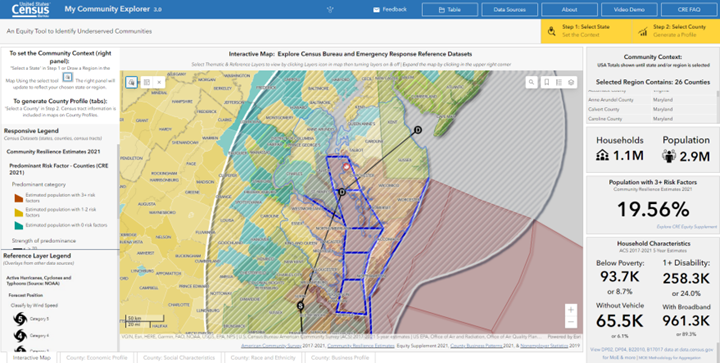
Screenshot: MCE interactive tool showing Tropical Storm Ophelia. Tropical Storm Ophelia was a strong but short-lived tropical storm that impacted the East Coast of the United States in September 2023.
More Stats
From Topics / Emergency Management / Disasters / Tools:

From data.census.gov > Profiles:
Get an overview of your state, county, or place all in one location with our geo-profile pages. They provide high-level statistics about your area regarding people and population, race and ethnicity, families and living arrangements, health, education, business and economy, employment, housing, and income and poverty.

Source: 2021 American Housing Survey (AHS).
Source: 2021 County Business Patterns (CBP).
From the Library / America Counts: Stories Behind the Numbers:
From the Newsroom / Stats for Stories (SFS):
Outside Links

Note: The National Hurricane Center is part of the National Oceanic and Atmospheric Administration (NOAA), a scientific agency within the U.S. Department of Commerce.